By Emma Weber - AI Transformation Advisor and Author. Emma Weber has spent 23 years in behaviour change and learning transfer, helping organisations globally navigate the human side of AI transformation. Founder of Being Human in the Age of AI.
← All posts
Foundation
What does being human mean - and why does it matter more now?
15 April 2026
·
6 min read
·
Emma Weber
I know. It sounds like the kind of question you'd save for a philosophy seminar, not a Monday morning with a full inbox.
But bear with me. Because right now, as AI agents take over more of the cognitive work that used to define professional value - the research, the analysis, the drafting, the processing - the most important strategic question a leader can ask is this: what is the human actually for?
If you can answer that clearly, you have a compass for every AI decision you'll face. If you can't, you risk creating something impressive-looking that quietly hollows out your organisation - and your people.
The machine does the doing. What does the human do?
For most of our working lives, professional identity has been built around the doing. Our confidence, our sense of progress, our proof of value - all of it anchored in what we produce. Deliverables. Output. Volume.
That's changing faster than most organisations are ready for.
In the framework I use - Be, Do, Have - we need to be in a certain way as we do certain tasks in order to have certain outcomes. For most of history, the emphasis was on the Do. With AI agents handling more and more of the Do, the human opportunity - the only one that really matters - is to focus on the Be. Orchestration. Evaluation. Strategic direction. Judgement. The wisdom that comes from slowing down rather than speeding up.
AI can keep intelligence, we keep wisdom.
Arianna Huffington
And she's right. If we compete against machines on intelligence - on information processing, pattern recognition, speed of output - we've already lost. But machines will not become wise. Wisdom requires something different. It requires stillness. Emotional depth. The kind of knowing that only comes from being fully, genuinely human.
The speed paradox
Here's the central paradox of this moment: as machines get faster, the human opportunity is to slow down.
AI agents are superhumanly productive. Speed, processing, execution, pattern recognition - this is what they're built for. Organisations chasing productivity on those terms are essentially racing machines on machines' ground. The scarcest resource in an AI-abundant world is not intelligence. It's wisdom. And wisdom can't be automated. It can't be scaled through a model. It accumulates through experience, through failure, through the willingness to sit with ambiguity rather than resolve it too quickly. It lives in the quality of a leader's attention, their capacity for genuine curiosity, the courage to make a call when the data stops short.
Yet most organisations are doing the opposite. Research from UC Berkeley, embedded inside a real company over eight months, found that as AI freed up people's time, their to-do lists expanded to fill every hour - and then kept going. Harvard Business Review published a piece in early 2026 with a title that should give every CEO pause: "AI Doesn't Reduce Work - It Intensifies It." BCG named the result "AI brain fry" - workers experiencing more mistakes, slower decision-making, and higher fatigue precisely because of the pace AI enables. The people burning out fastest were the ones who had embraced AI the most.
We are using the most transformative technology of our generation to accelerate the very patterns that were already breaking us. (And I say that having spent 23 years watching organisations do exactly this with every wave of change - it's a very human pattern!)
Five things that are genuinely, irreducibly human
Being human in the age of AI is not a slogan. It points to something specific - a set of capabilities that matter more now, not less, and that no agent will replicate any time soon.
The first
Judgement under uncertainty
AI is extraordinary at processing known information. It is not built to sit with genuine not-knowing and make a call anyway. That's a human skill. And right now, it might be the most important one a leader can bring.
The second
Real emotional intelligence
Not the kind that means managing your emotions in the workplace - but the kind that enables you to leverage them. Understanding what an emotion is actually telling you is how people know themselves better. And that's where leaders access true wisdom. It can't be outsourced.
The third
Curiosity that survives time pressure
Curiosity is where the big wins lie. But it doesn't survive under stress - when people are panicked, operating from a sense of shortage, they want the quickest answer. The leaders who will navigate this well are the ones who protect their own capacity for slow, genuine inquiry, and create conditions where the people around them can do the same.
The fourth
Body wisdom
This unlocks the kind of pattern recognition that goes beyond cognition - drawing on relationships, context, history, and the full texture of what it means to be in an organisation with your whole physicality, not just a brain tapping at a keyboard. Agents don't have this. They genuinely can't access the physical world.
The fifth
Agency
In yourself first, and then extended to the people around you. Agency means playing to your strengths, being trusted to make decisions, staying connected to what lights you up. AI can expand agency dramatically, if we choose to use it that way. Or it can shrink it, if we use it to surveil, micro-manage, and optimise humans the way we optimise machines. That choice is ours to make.
Why it matters more now
Before AI arrived, the system was already broken. And if we're being honest, we need to sit with that for a moment before we talk about what comes next.
Gallup's 2024 data found that only 21% of employees globally were engaged at work. Sixty-two percent disengaged. Fifteen percent actively working against their organisation's interests. Manager engagement was collapsing - down from 30% to 27% - and 70% of team engagement flows from the manager.
Gallup, State of the Global Workplace 2024
We'd spent decades and billions on leadership programmes and culture change initiatives. And still - four in five people showing up not fully present. AI didn't create this. It turned the lights on.
Layering powerful technology onto broken human systems doesn't fix them - it amplifies the damage. Seventy percent of digital transformations fail. McKinsey's research is consistent: culture, not technology, is the single biggest barrier to successful transformation. Organisations that invest heavily in culture change see 5.3 times higher success rates than those taking a technology-only approach.
The question is no longer whether to adopt AI. That's decided. The question is whether you'll do the human work that makes it land.
Tend to your lamp
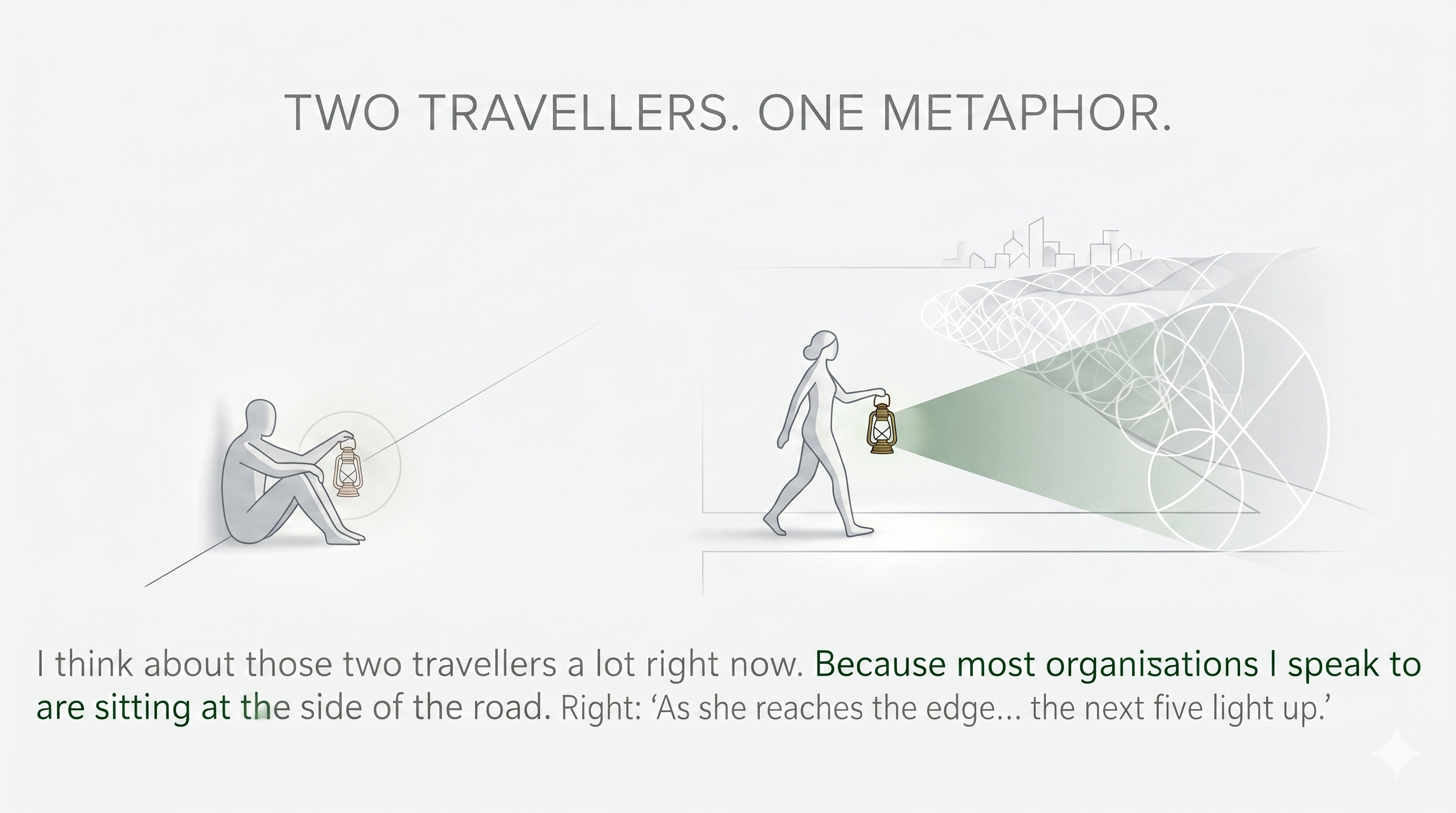
I use the metaphor of two travellers on a road in 1910 - before electric street lighting had reached the smaller towns. Both carrying oil lamps throwing about five metres of light into the darkness.
One stops. "I can only see five metres ahead. I'll wait for sunrise." The other starts walking. She knows it's uncertain. She doesn't have the full picture. But she knows that as she reaches the edge of her five metres, the next five will light up. She crosses the town before sunrise.
The lamp is your light. Your wisdom, your judgement, your humanity. Tend to it. If the fear, or the busyness, or the uncertainty starts to dim it - pay attention to that. Because everything else flows from the state of your light.
Being human matters more now not because machines are threatening to replace us. It matters because the organisations that will thrive in this moment will be led by people who have done the inner work - who know what they stand for, who move with both urgency and wisdom, and who create the conditions for the people around them to do the same.
The agents are here. The question is whether we'll use them to find our agency. Five metres of light is enough to start walking.
Which of the five feels most urgent in your organisation right now? I'd genuinely love to hear what you're noticing.
(Feel free to share in the comments, or if you'd prefer - I'm always up for the conversation.)
Emma Weber is the founder of Being Human in the Age of AI. She has spent 23 years in behaviour change and learning transfer, working with organisations globally - and she's now focused entirely on the human side of AI transformation, working with executive and CEO audiences on what it actually takes to navigate this shift well.
Ready to go further
Most organisations think they're further ahead than they are. Some are further ahead than they think. The Assessment tells you which.
Take the AI Transformation Readiness Assessment
Around 12 minutes. No login required. We'll send your results.
Sources
- Gallup (2024). State of the Global Workplace Report 2024. gallup.com
- Ye, X. M. and Ranganathan, A. (2026). "AI Doesn't Reduce Work - It Intensifies It." Harvard Business Review, February 2026. hbr.org
- BCG (2026). "When Using AI Leads to Brain Fry." Harvard Business Review, March 2026. hbr.org
- McKinsey & Company. Why do most transformations fail? mckinsey.com
- Huffington, A. "AI can keep intelligence, we keep wisdom." LinkedIn, November 2025.
Frequently asked questions about being human in the age of AI
What does "being human in the age of AI" actually mean?
Being human in the age of AI points to something specific - a set of capabilities that matter more now, not less, as AI agents take over more cognitive work. These include judgement under uncertainty, genuine emotional intelligence, curiosity that survives time pressure, body wisdom, and agency. The central question for any leader is: what is the human actually for? If you can answer that clearly, you have a compass for every AI decision you will face. If you cannot, you risk building something impressive-looking that quietly hollows out your organisation and your people.
What five human qualities matter most as AI agents take over more work?
Emma Weber identifies five human qualities that are genuinely irreducible in an AI-abundant world. First, judgement under uncertainty - AI processes known information brilliantly but cannot sit with genuine not-knowing and make a call anyway. Second, real emotional intelligence that goes beyond managing emotions to leveraging them and accessing deeper wisdom. Third, curiosity that survives time pressure - slow, genuine inquiry that stress and urgency cannot sustain. Fourth, body wisdom - the pattern recognition that comes from being physically present in an organisation. And fifth, agency - in yourself first, then extended to others.
Why is the human opportunity to slow down as machines speed up?
AI agents are superhumanly productive - built for speed, processing, execution, and pattern recognition. Organisations that chase productivity are essentially racing machines on machines' terms. The scarcest resource in an AI-abundant world is not intelligence - it is wisdom. And wisdom cannot be automated. BCG research found that the workers burning out fastest from AI adoption were the ones who had embraced it most eagerly - filling every freed hour with more work rather than using the space for deeper human thinking.
Why is wisdom more valuable than intelligence in an AI-abundant world?
As Arianna Huffington has said: "AI can keep intelligence, we keep wisdom." AI is extraordinary at intelligence - information processing, pattern recognition, speed of output. But wisdom requires something different: stillness, emotional depth, and the kind of knowing that only comes from being fully human. Wisdom accumulates through experience and failure. It lives in the quality of a leader's attention, their capacity for genuine curiosity, and the courage to make a call when the data stops short. These are not capabilities that can be scaled through a model.
Is AI a threat to human workers?
The real question is not whether AI will replace humans, but whether leaders will use AI to expand human agency or to shrink it. AI can free people to exercise their distinctly human capabilities - judgement, wisdom, genuine curiosity, meaningful relationships. Or it can be used to surveil, micro-manage, and optimise humans the way we optimise machines. That choice belongs to leadership. Research from Gallup and McKinsey consistently shows that organisations which invest in the human side of transformation significantly outperform those that treat AI as purely a productivity tool.